
A few years ago, I believed great software ideas started with brilliant coding skills, knowledge of frameworks, or expertise in the latest Python libraries.
Then I began sitting with business users. HR managers. Recruiters. Finance teams. Operations executives. Customer support teams.
✨ I noticed something interesting.
They never walked into a meeting saying, "We need a Python application using pandas and FastAPI." Instead, they walked in carrying frustrations.
- "This takes forever."
- "I can never find what I need."
- "We receive too many emails."
- "Everyone makes different decisions."
The more I listened, the more I realized that successful developers don't begin with code. They begin with curiosity. They climb a ladder of discovery, one rung at a time, uncovering the real problem before writing a single line of code.
Every rung reveals a different type of opportunity. Every opportunity points toward a different kind of Python solution.
⏰ Escaping the Time Trap
👉 A finance executive spends three hours every morning compiling reports. An HR professional manually updates spreadsheets every week. A project manager copies information from one system to another day after day.
🗣️ The complaint: "This takes forever."
A developer asks:
- 🛠️What steps are performed every time?
- 🛠️Which activities follow a fixed sequence?
- 🛠️What data is being moved?
- 🛠️What triggers the process?
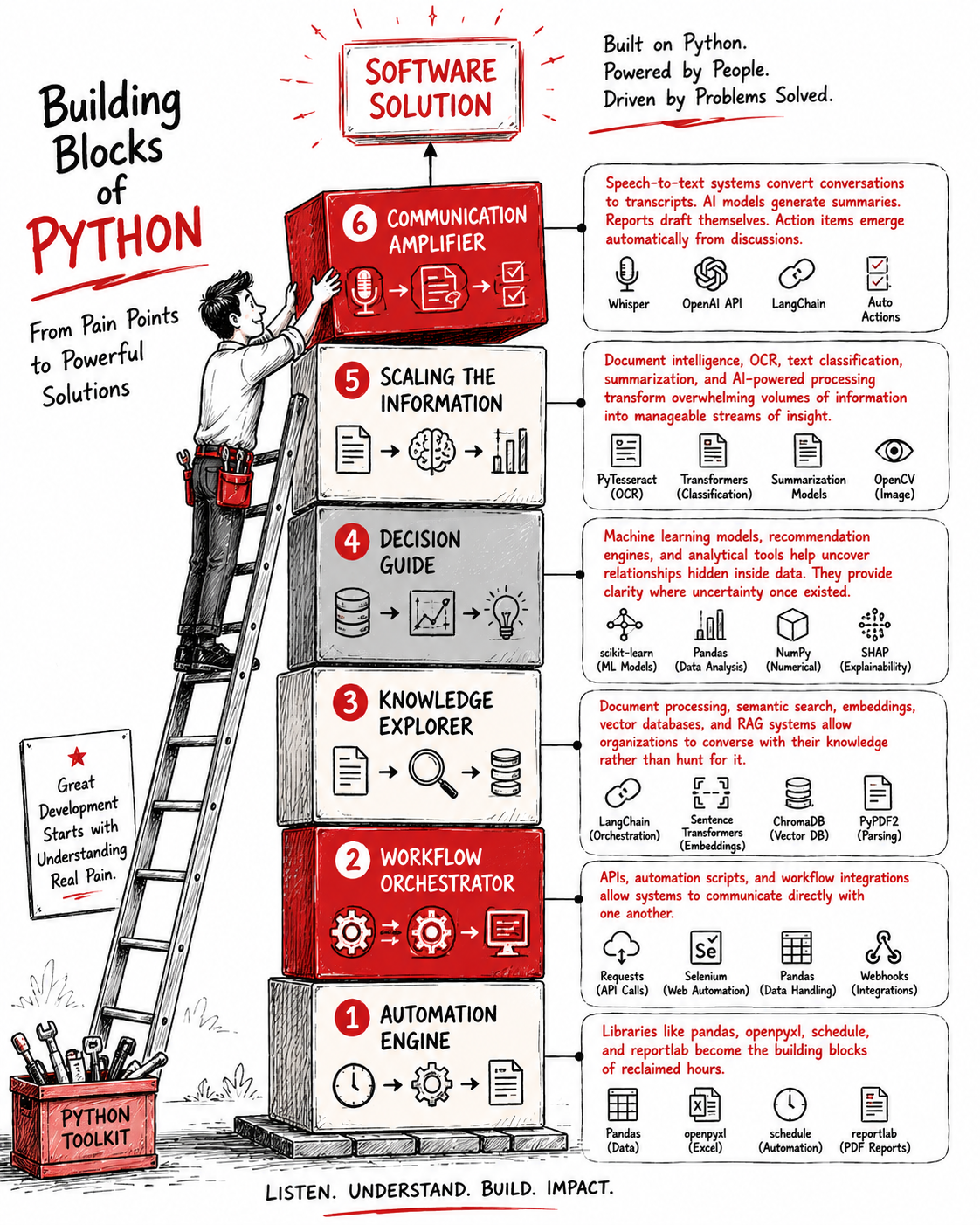
This is not a people problem. It is an automation problem. Python steps in as a tireless assistant, reading files, processing data, generating reports, sending emails, and performing routine tasks without fatigue.
🧱 Building Blocks
pandas, openpyxl, schedule, reportlab
🎯 The goal isn't faster employees. The goal is eliminating work that should never have required a human in the first place.
🔄 Breaking the Endless Loop
👉 A recruiter enters the same candidate information into multiple systems. A customer support executive copies details from one portal into another. A sales coordinator updates identical information across several applications.
🗣️ The complaint: "I keep doing the same thing again and again."
A developer asks:
- 🛠️Where does information originate?
- 🛠️Where does it travel?
- 🛠️Which systems already contain the required data?
- 🛠️Can one action trigger many actions?
Instead of asking people to become more efficient at repetitive work, Python can remove the repetition altogether. APIs, automation scripts, and workflow integrations allow systems to communicate directly with one another.
🧱 Building Blocks
APIs, automation scripts, workflow integrations
🎯 Humans stop acting as connectors between software systems. The software starts doing that job itself.
🔍 Finding the Lost Library
👉 Policies sit in folders. Knowledge lives inside PDFs. Customer information is buried in emails. Valuable insights are trapped in documents that nobody remembers exist. Employees repeatedly ask the same questions because searching has become harder than asking.
🗣️ The complaint: I know it's somewhere, but I don't know where.
A developer asks:
- 🛠️Where does knowledge live?
- 🛠️How is it organized?
- 🛠️What questions are people asking repeatedly?
- 🛠️Which information is most difficult to locate?
At this rung, Python transforms from an automation tool into an explorer. Document processing, semantic search, embeddings, vector databases, and RAG systems allow organizations to converse with their knowledge rather than hunt for it.
🧱 Building Blocks
document processing, semantic search, embeddings, vector databases, RAG systems
🎯 The real objective isn't storing more information. It is making information accessible exactly when it is needed.
🧭 Navigating the Fog of Decisions
👉 Two people review the same case and arrive at different conclusions. Two managers assess the same employee differently. Two underwriters evaluate identical applications and produce different outcomes.
🗣️ The complaint: "It depends on who reviews it."
A developer asks:
- 🛠️What factors influence the decision?
- 🛠️What criteria matter most?
- 🛠️What historical decisions are available?
- 🛠️Are there indicators that consistently lead to successful outcomes?
At this rung, Python becomes a guide. Machine learning models, recommendation engines, and analytical tools help uncover relationships hidden inside data. Rather than replacing human judgment, they provide clarity where uncertainty once existed.
🧱 Building Blocks
machine learning models, recommendation engines, analytical tools
🎯 The destination isn't automated decision-making. It's better decision-making.
📊 Scaling the Mountain of Information
👉 The business grows. More customers arrive. More documents appear. More emails flood inboxes. More resumes enter the recruitment pipeline. More transactions flow through systems. What was once manageable becomes overwhelming.
🗣️ The complaint: "There is simply too much to handle."
A developer asks:
- 🛠️What needs classification?
- 🛠️What needs prioritization?
- 🛠️What can be summarized?
- 🛠️What patterns matter most?
At this stage, Python becomes a force multiplier. Document intelligence, OCR, text classification, summarization, and AI-powered processing transform overwhelming volumes of information into manageable streams of insight.
🧱 Building Blocks
document intelligence, OCR, text classification, summarization, AI-powered processing
🎯 The challenge is no longer generating information. It is helping people focus on the information that matters.
🎙️ Amplifying Human Communication
👉 Meeting notes. Status reports. Emails. Presentations. Summaries. Documentation. Organizations generate vast amounts of communication every day, and much of it follows predictable patterns.
🗣️ The complaint: "I spend more time documenting work than doing work."
A developer asks:
- 🛠️Which content is repeated?
- 🛠️Which reports follow templates?
- 🛠️Which meetings require summaries?
- 🛠️Which updates are created manually?
At this point, Python becomes an amplifier. Speech-to-text systems convert conversations into transcripts. AI models generate summaries. Reports draft themselves. Action items emerge automatically from discussions.
🧱 Building Blocks
speech-to-text systems, AI summarization models, report generation tools
🎯 The objective isn't replacing communication. It is removing the effort required to create it.
And when you finally reach the top of the ladder, you realize something important.
The journey was never about Python. Python was simply the toolkit. The real skill was learning to listen.
Every complaint was a clue. Every frustration was a signal. Every rung revealed a hidden opportunity waiting to be discovered.
The best developers don't start with code.
They start with curiosity.
And one conversation at a time, they climb the ladder from frustration to impact. 🚀
Quick Assessment
Test your understanding of the Python Opportunity Ladder with 5 questions.
Q1.According to the article, what is the FIRST rung of the Python Opportunity Ladder?
Q2.Which Python libraries are mentioned as building blocks for automating repetitive time-consuming tasks (Rung 1)?
Q3.At Rung 3 (Finding the Lost Library), Python transforms into what kind of tool?
Q4.What does the article say is the real destination at Rung 4 (Navigating the Fog of Decisions)?
Q5.What is the central insight the author shares at the top of the ladder?